
 Call a Friend
 Create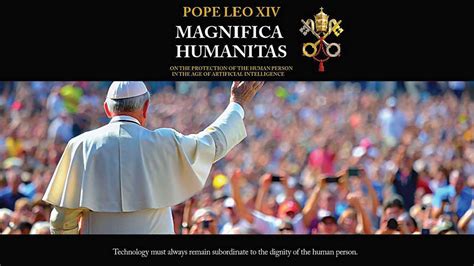
In an era increasingly shaped by algorithms, automation, and artificial intelligence, Pope Leo XIV has released a remarkable new encyclical titled Magnifica Humanitas — “The Greatness of Humanity.”
Regardless of religious belief, it is difficult to ignore the deeper question at the center of the document:
What does it mean to remain fully human in a technological age?
The encyclical arrives at a moment when digital systems increasingly shape not only economies and politics, but also attention, identity, relationships, emotional life, and even the way human beings understand themselves. Artificial intelligence now writes text, generates images, predicts behavior, curates information, moderates speech, influences elections, and increasingly mediates everyday human interaction. For many people, technology no longer feels like a tool sitting outside life. It feels woven into consciousness itself.
Against this backdrop, Magnifica Humanitas is not a rejection of technology. Nor is it a nostalgic call to retreat from modern life.
Instead, the document offers something more thoughtful and more difficult: a moral examination of the values quietly being embedded into digital culture.
Throughout the encyclical, Pope Leo XIV returns repeatedly to the idea of human dignity — the belief that a person possesses worth that cannot be reduced to productivity, utility, popularity, efficiency, or data. The concern is not merely that technology is becoming more powerful. The concern is that modern societies may increasingly begin to evaluate human beings according to technological logic.
In highly optimized systems, measurable things tend to dominate. Engagement becomes more important than reflection. Speed becomes more valuable than wisdom. Visibility begins to replace substance. Emotional stimulation outcompetes emotional depth.
The result is a culture that can become perpetually reactive, distracted, performative, and psychologically exhausted.
One of the more striking aspects of the encyclical is its recognition that technological systems are never neutral. Platforms, algorithms, recommendation engines, and AI models all contain assumptions about what should be rewarded, amplified, prioritized, or ignored. Over time, these systems influence social norms and human behavior in ways that are often subtle enough to feel invisible.
Modern digital culture is frequently optimized around metrics: clicks, views, retention, outrage, virality, monetization, and behavioral prediction. But human flourishing rarely operates according to those same metrics.
A meaningful friendship cannot be measured in impressions.
Wisdom rarely goes viral.
Emotional maturity usually develops slowly, quietly, and privately.
The encyclical suggests that societies built primarily around stimulation and optimization may unintentionally erode the very conditions required for healthy human life: contemplation, patience, moral responsibility, meaningful work, trust, empathy, community, and the capacity for genuine presence.
Particularly notable is the Pope’s concern about the erosion of shared truth.
The modern information environment often rewards certainty over nuance, reaction over understanding, and tribal identity over honest inquiry. Algorithms trained to maximize engagement naturally learn that fear, anger, conflict, and emotional intensity tend to hold attention more effectively than calm reflection. The consequence is not simply political polarization. It is a gradual fragmentation of social reality itself.
When every person inhabits a personalized informational world, maintaining social trust becomes increasingly difficult.
The encyclical warns that technological systems capable of shaping perception at massive scale carry enormous moral responsibility. Truth, it argues, cannot survive indefinitely in environments optimized primarily for emotional manipulation and commercial extraction.
This concern extends beyond politics into psychology and daily life.
Many people increasingly describe modern online existence as emotionally draining despite unprecedented connectivity. Social platforms can create the sensation of constant visibility without genuine intimacy. Communication becomes continuous, yet loneliness persists. Individuals feel pressure to curate identity, manage perception, perform emotion, and maintain relevance within systems that rarely encourage vulnerability, slowness, or authentic presence.
The result can be a peculiar form of emotional malnutrition: constant stimulation paired with diminishing depth.
Magnifica Humanitas speaks directly into this tension.
The document argues that human beings are not machines to be optimized. Consciousness, empathy, moral judgment, spiritual longing, creativity, and love cannot be fully replicated through computation or reduced to predictive systems. Even highly advanced artificial intelligence, the Pope argues, does not possess human dignity simply because it can imitate aspects of human cognition.
This distinction matters because civilizations often become shaped by the metaphors they adopt.
If human beings begin seeing themselves primarily as programmable systems, biological computers, or collections of behavioral data, then social institutions may increasingly prioritize control, prediction, efficiency, and optimization above compassion, wisdom, and moral development.
The encyclical therefore insists that technological progress must remain subordinate to ethical responsibility rather than replacing it.
Another major theme of the document concerns work and economic life.
For centuries, work has been understood not only as a means of survival but also as a source of purpose, contribution, structure, dignity, and social participation. The encyclical acknowledges that automation may deliver extraordinary gains in efficiency and productivity, but warns that societies must think carefully about what happens when large numbers of people begin to feel economically unnecessary.
A civilization in which human beings lose meaningful participation may become materially advanced while psychologically unstable.
The Pope does not condemn innovation itself. Instead, he questions whether technological progress detached from moral reflection can genuinely be described as progress at all.
This concern becomes particularly serious in discussions surrounding artificial intelligence and decision-making authority.
The encyclical strongly argues that human accountability must remain central in matters involving justice, warfare, governance, and social power. Decisions involving life, dignity, punishment, or violence should never be surrendered entirely to opaque automated systems.
Efficiency alone cannot serve as the highest moral principle.
The document also expresses concern for children and adolescents growing up inside highly engineered digital environments. Young people now encounter algorithmic systems before developing emotional resilience, identity stability, or critical judgment. The consequences of prolonged exposure to stimulation-driven digital environments remain poorly understood, particularly regarding attention, anxiety, self-worth, social comparison, and psychological development.
This is not presented as a simplistic anti-technology argument. The encyclical openly acknowledges the extraordinary benefits technology can provide in medicine, education, communication, scientific research, accessibility, and human collaboration. Rather, the argument is that powerful technologies require equally serious ethical frameworks.
Human intelligence, the Pope suggests, must be accompanied by moral maturity.
One reason the encyclical has attracted attention far beyond religious circles is that many of its concerns already resonate widely across secular society. Increasing numbers of people sense that modern digital life often feels simultaneously hyperconnected and emotionally thin. There is growing public discomfort around surveillance capitalism, addictive platform design, AI-generated misinformation, declining attention spans, online hostility, and the commercialization of nearly every aspect of human interaction.
Even among nonreligious audiences, there appears to be a growing intuition that technological capability alone cannot answer deeper human questions about meaning, identity, belonging, purpose, love, and moral responsibility.
That may ultimately explain why Magnifica Humanitas feels culturally significant.
The document does not offer technical solutions or policy blueprints. Instead, it attempts something rarer: it asks whether modern societies still possess a coherent moral vision of the human person.
At its heart, the encyclical argues that civilizations flourish not merely through intelligence or efficiency, but through their ability to preserve human dignity within systems of power.
Technology can extend human capability enormously.
But it cannot tell societies what human beings are ultimately for.
And perhaps that is the central warning running quietly beneath the entire document:
A civilization capable of building increasingly intelligent machines must be careful not to become less human in the process.
Citation:
Pope Leo XIV, Magnifica Humanitas (2026), Vatican Press. Available at: https://www.vatican.va/content/leo-xiv/en/encyclicals/documents/20260515-magnifica-humanitas.html